
If I were giving this blog post to you as a presentation, I would have you close your eyes. I would ask you to picture a situation in your daily work life where you have been given a solution or process without being consulted on how that solution or process would be utilized. I’m sure that each of you reading this post could easily imagine such a situation. The first time I encountered a situation like this was when I was in medical school. In a clinical skills class, one of my professors was lamenting that the paper towel dispenser had been changed in the clinical skills room without consultation with the end user. I thought this was a simple but profound statement, but I didn’t do anything with it then. With the benefit of having worked in the medical field for a long time, I completely understand what he meant. I am sure that during the time you spent closing your eyes at the start of this post, you could think of a similar situation that occurred to you in your day-to-day life. What I used to think were inconveniences and frustrations I now realize to be simply poor design decisions.

You might think it’s strange that a medical doctor is talking about design stop; however, I, along with several other physicians, particularly in northern America, believe that medicine is inherently and necessarily a primarily creative field. Where I work in the emergency department, this is particularly evident. Let me paint you a scenario: a patient is brought into the emergency department by ambulance as a code 3. For those of you who are not familiar with this terminology, code 3 is a very sick patient who requires urgent management. This can range from an acute stroke, acute heart attack, or cardiac arrest. The patient is a young gentleman in his late 20s who was found nonresponsive. When emergency medical services started to interact with the patient, he became pretty agitated but was not making any sense and seemed to be complaining of pain in his right arm. Clinical features included pinpoint pupils and intermittent bradypnea and apnea. When the patient is transferred from the EMS Gurney to the hospital bed, he is sleeping reasonably comfortably, but mostly because he has bradypnea and has altered mental status. In presenting this case, it is clear that you have a significant problem with minimal data to support decisions about how you will care for this man. So I’ll ask the question, how is this not creative, and to that end, how can we not use design to create better solutions so we can most effectively care for this man? But what is the first step?
In medicine, we are stuck in the paradigm of traditional constructivism. I have distilled this concept down to this. Learners learn best by having an experience; therefore, those with said experiences or wisdom are best placed to create solutions. The problem with this approach is that while a solution could be ideally generated – is it solving the correct problem?
This is where design has an opportunity to shine! In medicine, we are solution-focused when we should be problem-focused. Remember when you learned algebra in high school and were asked to “solve for X”? The first thought that always came through my brain was, “How can I solve for X when I don’t know what X is!”. Using design, the focus remains relentless in determining what X is and understanding how end users interact with X before starting to “solve for X.” Hopefully, you are beginning to understand why problem-solving in healthcare traditionally takes the wrong approach. If you are now questioning how we can focus on understanding the problem, congratulations – you are on track! Welcome to the world of human-centered design (HCD).

HCD is a set of frameworks that can be applied to solving complex problems. In healthcare, HCD represents an intriguing and effective way to understand the issues and how they affect end users. HCD is holistic and involves discovering the needs of the humans interacting with the eventual solutions. The result is a prototype that is understandable and usable. The prototype is sustainable and achieves its objectives in a meaningful and desirable way. 1 Many different frameworks have been described. The most common is Design Thinking, which I have utilized several times. I like it because it has some structure that we in medicine are familiar with – a more linear approach and gives some steps that designers can follow to achieve the goals of understanding the problem and then undertaking design iterations. My colleague and I created a graphic to visualize the steps of design thinking.
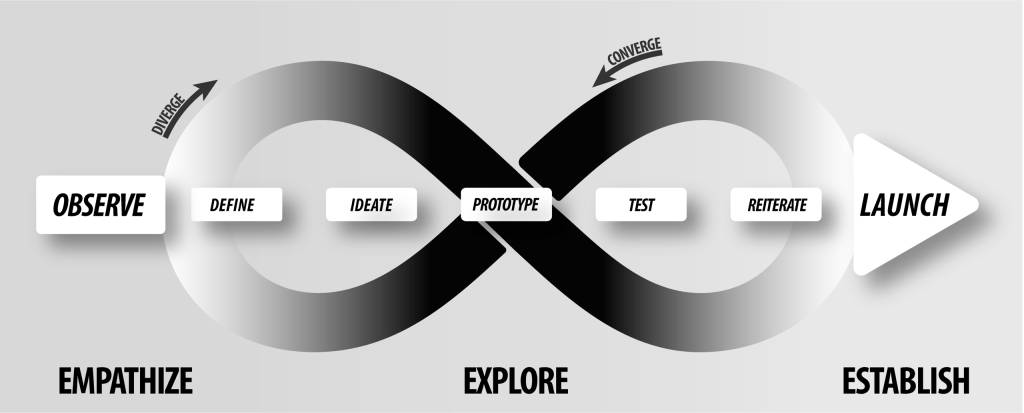
So, if you have made it this far in reading this blog post – why don’t you give an HCD approach a look when you next are trying to solve a problem in your healthcare setting? I promise you it will be something you won’t regret!
1. Melles M, Albayrak A, Goossens R. Innovating health care: key characteristics of human-centered design. Int J Qual Health Care. 2020;33(Suppl 1):37-44. doi:10.1093/intqhc/mzaa127
 Medical Bites - Complex Topics Bite Sized
Leave a comment