
She’s doing CrossFit while pregnant – seems dangerous! Before I went to medical school, I was a strength and conditioning coach. Mostly, I worked with young people who weren’t yet starting families, but I did undertake postgraduate training in Obstetrics and Gynecology and counseled women on exercise during and after pregnancy. It strikes me that with the rise of professional women’s sports now in the spotlight more and more, namely through my favorite sport (soccer/football), I wonder what data exists to support decisions for women returning to play/exercise after pregnancy. Turns out there’s a scoping review to answer this very question!

Title:
Navigating the ‘new normal’: what guidelines exist for postpartum return to physical activity and sport? A scoping review. 1
Population:
Females who were postpartum and recommendations for exercise in this population.
Intervention:
Studies that provided recommendations or guidelines for return to activity (RTA) or return to sport (RTS). Search CINAHL, Embase, Medline, PsycINTO and SPORTDiscus with secondary studies giving recommendations.
5851 studies were screened, and 33 were included.
Comparison:
Assessment of the recommendations that were outlined in the 33 manuscripts found that return to play (RTP) was ‘medically safe’ at 6 weeks and that engaging in 150 minutes of moderate-vigorous activity per week is optimal.
Outcome:
Overall, this scoping review found inconsistent, evidence-based recommendations for RTP postpartum, and they called for more research to inform patient and activity-specific guidelines for safe and successful RTP.

30,000ft view:
Pregnancy is a challenging time in a woman’s life. It is a time when the body changes significantly, including reduced bone mineral density (<1-9% per pregnancy), joint laxity (including sacroiliac joint laxity), increased insulin levels during pregnancy, and risk of gestational diabetes and subsequent development of DM2. 1 So women need to get through 9 months of pregnancy, delivery of the baby (including possible complications), including the risk of hypertension, postpartum hemorrhage, diabetes, major abdominal surgery (C-section), and more! She then needs to recover from the delivery, figure out breastfeeding, deal with sleep deprivation, and connect with themselves, their family, and their friends. It’s a big deal and one of the hardest things you can do! No wonder around 1 in 2 women never return to playing sports or activity after pregnancy. This scoping review is a significant first step for assessing the state of the literature concerning how best to advise women when they are ready to get back to exercising. Overall, the data was of low quality, and there was significant heterogeneity of the studies included in this scoping review. They found some topline areas that should be considered.
Early postpartum period (0-6 weeks):
- Walking straight away
- Pelvic floor exercises
Breastfeeding:
- Recommend feeding/pumping before going out to exercise.
Biopsychosocial considerations:
- Six studies recommended the importance of “whole system readiness.” Areas include physical conditioning, changes to body mass, sleep patterns, breastfeeding, postpartum fatigue & thyroiditis, socioeconomic considerations, and fear of movement.
Screening:
- Musculoskeletal function, pelvic health, mental health, fatigue/sleep, nutrition, and breastfeeding
- Several validated screening tools exist, including the Edinburgh Postnatal Depression Scale and the Pelvic Floor Disability Inventory Short Form.
Strength Training:
- Exercises that target major muscle groups (quads, glutes, hamstrings, calf complex, triceps, pecs, trapezius, and shoulders)
- Starting with body weight and progressing each week
- Sessions on alternate days
- 1-3 sets of 8-12 reps using 8-10 exercises
- Progressing weight by 2-10% each week
Aerobic Training:
- Walking immediately after pregnancy
- Cycling after six weeks if no laceration repair
- Running after 12 weeks
- There are various recommendations for duration, but generally starting at 10-15 minutes and progressing by roughly 10% per week.
Return to sport:
- Variability in recommendations but overall running after 12 weeks and then gradual return to sport with volume first followed by intensity
How should this modify your practice:
This was a comprehensive scoping review that assessed the state of the literature concerning return to activity/sport. Overall, more research is necessary, but there are some decent resources that are available to guide the care of women in the postpartum period. I will take a holistic approach to providing advice for women who are in the postpartum period. Importantly this should start prior to pregnancy with building strong habits and then supporting our families to continue to be healthy through all stages of life.
Author: Dr Adrian Cois, MD
Assistant Professor
Emergency Medicine
@dr_cois
Extend Yourself:
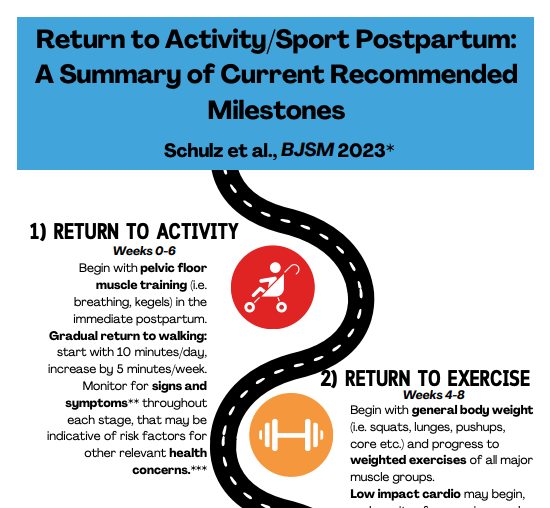
There is a great infographic published in @BJSM by the same authors of the scoping review. You should check it out here! 2
References:
1. Schulz JM, Marmura H, Hewitt CM, Parkinson LJ, Thornton JS. Navigating the ‘new normal’: what guidelines exist for postpartum return to physical activity and sport? A scoping review. Br J Sports Med. 2023;57(24):1573-1578. doi:10.1136/bjsports-2023-107166
2. Schulz JM, Thornton JS. Infographic. Return to activity/sport postpartum: a summary of current recommendations. Br J Sports Med. Published online February 14, 2024. doi:10.1136/bjsports-2023-107856
 Medical Bites - Complex Topics Bite Sized
Leave a comment