
Before going into medicine, I worked for 11 years as a sports performance specialist. Teams win because they have their best players fit and available to play. One of the most essential parts of my role was to structure training such that the training load would optimize the athletes’ physical capabilities while mitigating their risk of injury. Here, we will discuss a case study that uses a novel technique to see if we can optimize our athletes’ training during periods of illness.

Population:
A case study of a 30-year-old male elite marathon runner with a personal record of 2:18.00.
Intervention:
He performs daily orthostatic testing, which involves supine / standing HR and assessment of HRV. He completed a marathon and then became ill with a viral infection four weeks later.
Comparison:
The study assessed the patient’s resting HR with supine and standing before, during, and after viral infection. They also assessed the patient’s heart rate variability during the same intervals. They utilized orthostatic testing performed daily to determine the above parameters.
Outcome:
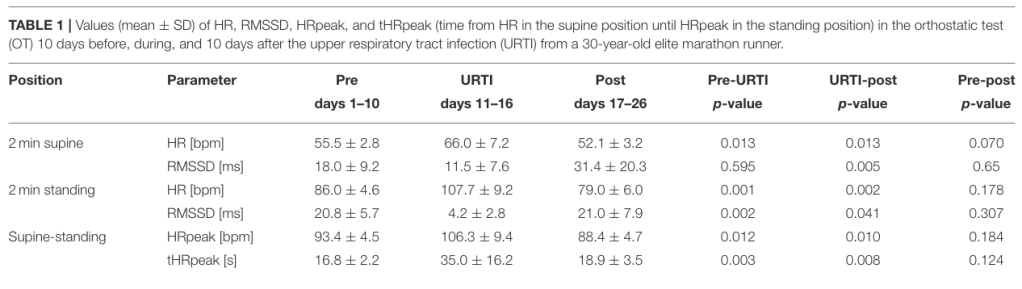
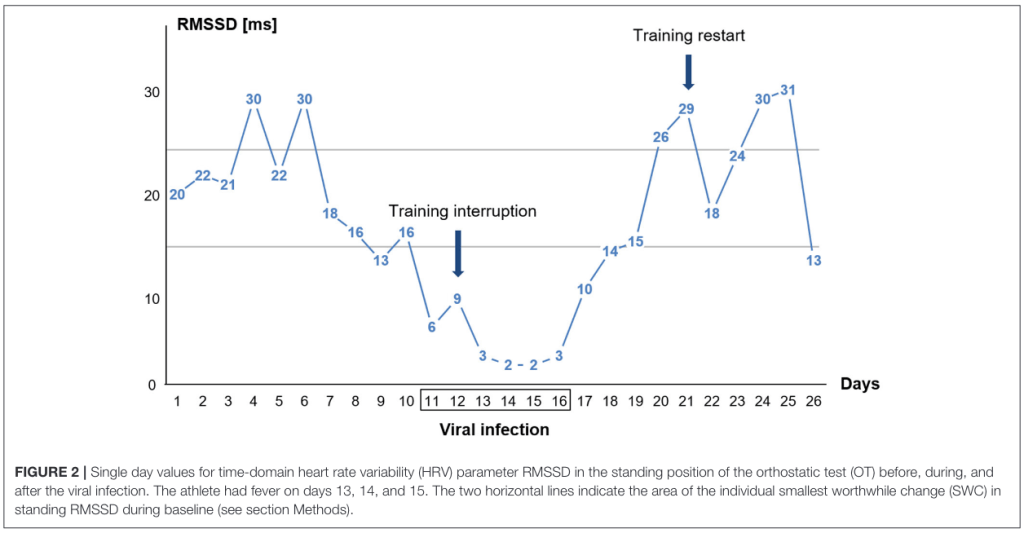
The case study demonstrated that HR and HRV increased when the patient was unwell with a viral upper respiratory tract infection.
- Supine HR +11bpm
- Standing HR +22
- HR peak +13bpm
- Time to HR peak +18 seconds
- RMSSD decreased from 20.8ms to 4.2ms (reduced HRV)
30,000ft view:
Just about everyone who is working out regularly has a personal fitness tracker. Many of these devices give some metrics of heart rate and heart rate variability. This case study gives some clues on how one could use these trackers on a daily basis. I am not an expert on heart rate variability, but my understanding of HRV assesses the push and pull between the sympathetic and parasympathetic nervous systems. Simply put – the sympathetic nervous system ramps up our fight or flight response – HR and BP go up, and our pupils dilate, ready to see everything that is coming at us. The parasympathetic nervous system slows everything down – HR and BP go down to help us go to sleep. There is a constant push and pull between these two systems – essentially HRV. When we see too little HRV, there can be many reasons – but in this case, decreased vagal tone results in an imbalance between the two arms of the autonomic nervous system. With a viral infection, it makes sense that HRV would be lower. When the body is fighting infection, there is a greater metabolic demand and, therefore, a higher need for cardiac output; the onset of fever often comes with tachycardia and increased sympathetic tone. To that end, when the insult goes away – the imbalance between the arms of the autonomic nervous system will resolve, and therefore, your HRV will return to normal. In this case study the reason the athlete was able to get the data was owing to the use of daily orthostatic testing.

How should this modify your practice:
If you are looking for a solution to predict when an athlete will get sick, this case study shouldn’t make you change your practice when monitoring athlete wellness. However, using a metric such as an orthostatic test represents a novel way of using a regular metric, which may help to understand the individual athlete’s response to training, stress, and sickness stimuli. Based on this case study, it would be reasonable to recommend using a daily orthostatic test as a regular metric, which may give a baseline to guide decisions around return to training.
Author: Dr Adrian Cois, MD
Assistant Professor
Emergency Medicine
@dr_cois
Extend Yourself:
- This is a nice article describing the physiology of HRV. 2 https://www.ncbi.nlm.nih.gov/pmc/articles/PMC4840584/
- I’ve been impressed by the work of Marco Altini PhD and would recommend you follow him on twitter.
https://twitter.com/altini_marco & https://t.co/F8UmrLufYD
References:
1. Hottenrott L, Gronwald T, Hottenrott K, Wiewelhove T, Ferrauti A. Utilizing Heart Rate Variability for Coaching Athletes During and After Viral Infection: A Case Report in an Elite Endurance Athlete. Front Sports Act Living. 2021;3:612782. doi:10.3389/fspor.2021.612782
2. DONG JG. The role of heart rate variability in sports physiology. Exp Ther Med. 2016;11(5):1531-1536. doi:10.3892/etm.2016.3104
 Medical Bites - Complex Topics Bite Sized
Leave a comment